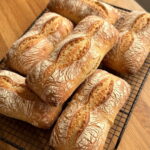
Ingredients
This recipe makes a batch of ciabatta portions.
- 500 g bread flour
- 350 g ice-cold water (adjust depending on flour absorption)
- 100 g active sourdough starter
- 10 g salt
- 25 g olive oil
Weighing ingredients on a kitchen scale is strongly recommended. Bread baking is about ratios, and grams are far more reliable than cups.
Instructions
In a large mixing bowl, combine the 500 g bread flour, 350 g ice-cold water, and 100 g active sourdough starter. Mix until no dry flour remains. It will look shaggy and rough, and that’s fine.
Cover the bowl and let the dough rest for 1 hour. This rest, often called an autolyse-style rest, lets the flour absorb water and begins gluten development without any effort from you.
Add the 10 g salt and 25 g olive oil. Mix thoroughly until both are fully incorporated. Wet your hand to prevent sticking and squeeze or fold the dough until the salt dissolves. The dough will be sticky and very high in hydration.
Cover the bowl and let the dough rest for 30 minutes.
With a wet hand, lift one side of the dough, stretch it upward gently, and fold it over toward the center. Rotate the bowl and repeat on all four sides.
Cover and rest for 30 minutes, then repeat the stretch-and-fold process. Do this 3 to 4 times in total. With each round, the dough should become smoother, stronger, and more elastic, even though it stays soft and wet.
Cover the dough and let it bulk ferment at room temperature until it is noticeably expanded, bubbly, and airy. This can take several hours depending on your starter’s strength and your kitchen’s temperature. Look for bubbles on the surface and sides, a jiggly texture, and a dough that has grown significantly. Don’t rely on the clock alone.
Generously dust your work surface with flour. Carefully turn the dough out, trying not to knock out the air you’ve built up. Dust the top lightly with flour too.
Gently stretch the dough into a rough rectangle. Using a dough scraper, divide it into ciabatta portions. Don’t try to make them perfectly neat. Rustic, irregular shapes are part of the charm.
Carefully move the portions onto a well-floured, parchment-lined baking tray. Use the scraper and floured hands to lift them gently, stretching slightly into slipper shapes.
Cover lightly and let the portions proof until puffy and airy, about 30 to 60 minutes. They should look pillowy and jiggle slightly when the tray is nudged.
Preheat your oven to 450°F (230°C), with a baking stone or heavy baking tray inside if you have one. A hot surface helps the bread spring up quickly.
Bake for approximately 20 to 25 minutes with steam, until the ciabatta is a deep golden brown. To create steam, place a metal tray on the lower rack and carefully pour in hot water as you load the bread, or spray the oven walls with water. Steam keeps the crust soft early on so the loaf can expand fully, then helps it turn crisp and glossy.
Remove the bread from the oven and move it to a wire rack.
Allow the bread to cool before slicing. The crumb is still setting inside, and cutting too early can make it gummy. Then slice and admire that open crumb.