Ingredients
- 3 cups bread flour
- 1½ cups warm water
- 1½ teaspoons salt
- ½ teaspoon instant yeast
Instructions
In a large bowl, combine the bread flour, salt, and instant yeast. Pour in the warm water and stir until a sticky, shaggy dough forms. Mix just until there is no dry flour left. The dough will look rough and wet, and that is exactly right. Do not add more flour.
Cover the bowl and leave the dough at room temperature for 12 to 18 hours, until doubled in size and bubbly. A plate, a damp towel, or plastic wrap all work as a cover. Place the bowl somewhere out of direct sunlight and away from drafts. The dough is ready when the surface is dotted with bubbles, the dough has domed up, and it jiggles when the bowl is shaken. In a warm kitchen, check closer to 12 hours. In a cool kitchen, it may need the full 18.
Lightly flour your work surface. Gently turn out the dough and fold the edges toward the center. Shape it into a round loaf without kneading. The dough will be sticky and loose. Use a bench scraper or floured hands to help. Fold the left, right, top, and bottom edges into the center like an envelope, then flip it seam-side down and gently tuck it into a round shape. Handle it as little as possible to preserve the air bubbles.
Place a Dutch oven with its lid inside the oven and preheat to 450°F (230°C) for about 30 minutes. A very hot pot is the secret to a crisp crust and strong oven spring. Allow a full 30 minutes so the pot is thoroughly heated through. While the oven heats, let the shaped dough rest on a piece of parchment paper, loosely covered.
Carefully place the dough on parchment paper and lower it into the hot Dutch oven. Cover with the lid. Use oven mitts, because the pot and lid are extremely hot. Lifting the dough by the parchment makes the transfer easy. If you like, score the top with a sharp knife or razor blade, making a shallow slash about ½ inch deep. Scoring is optional, but it helps the loaf expand in a controlled way.
Bake for 30 minutes with the lid on. During this stage, the trapped steam keeps the crust flexible so the loaf can rise and expand fully.
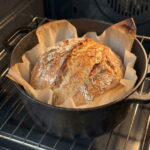
Remove the lid and bake for another 10 to 15 minutes, until the crust is deep golden brown and crispy. Watch the loaf closely during the final minutes. The bread is done when the crust is a rich golden brown and the loaf sounds hollow when tapped on the bottom. The internal temperature should reach about 205°F to 210°F (96°C to 99°C).
Carefully remove the bread and let it cool on a wire rack for at least 45 minutes before slicing. Cooling lets the interior finish setting. Slicing too early can make the crumb gummy and dense. You may hear the crust crackle as it cools, which is a good sign.