Ingredients
This recipe uses three basic ingredients, each of which plays an important role in the final texture.
Almond Flour: 2 Cups (About 200 g)
Almond flour provides the foundation of the loaf.
It is made from ground almonds and has a fine texture that works well in many grain-free baking recipes. Almond flour contributes a mild nutty flavor, fat, protein, and a tender crumb.
For this recipe, use finely ground almond flour rather than coarse almond meal whenever possible. Finely ground flour generally produces a more uniform batter and a smoother texture.
Measure the almond flour carefully. Too much can make the bread dense or crumbly, while too little may leave the loaf too soft to slice neatly.
For the most consistent results, use a kitchen scale and measure approximately 200 grams.
Plain Greek Yogurt: 1 Cup (245 g)
Greek yogurt adds moisture and a subtle tang to the bread.
It also contributes protein, although the exact amount depends on the brand and whether you use nonfat, low-fat, or full-fat Greek yogurt.
Choose plain, unsweetened Greek yogurt rather than a flavored variety. Added sugar and flavorings can change the taste and composition of the loaf.
Greek yogurt varies in thickness between brands. A thick, creamy product is generally a good choice because excess liquid can affect the batter’s consistency.
If the yogurt has separated in its container, stir it before measuring so the moisture is distributed evenly.
Eggs: 3 Large Eggs
Eggs help bind the almond flour and yogurt together.
As the bread bakes, the proteins in the eggs set and provide structure, allowing the loaf to hold its shape after cooling.
Instructions
Preheat your oven to 350°F (175°C).
Line a small loaf pan with parchment paper, making sure the bottom and sides are covered.
If necessary, lightly grease the pan first to help the parchment stay in place.
Preparing the pan before mixing the ingredients helps make the baking process smoother and prevents the batter from sitting unnecessarily.
Crack the three large eggs into a large mixing bowl.
Whisk until the yolks and whites are thoroughly combined.
You do not need to whip the eggs into stiff peaks or incorporate a large amount of air. The goal is simply to create a uniform mixture.
Evenly mixed eggs help distribute the ingredients throughout the batter and support a consistent texture.
Add the plain Greek yogurt to the beaten eggs.
Whisk until the mixture looks smooth and creamy.
Scrape down the sides of the bowl if yogurt collects around the edges.
At this stage, the mixture should be relatively uniform, with no large streaks of yogurt or egg remaining.
Gradually add the almond flour to the yogurt and egg mixture.
Stir with a spatula until the ingredients are fully combined and a thick batter forms.
Avoid overmixing once the flour has been incorporated. Almond flour does not develop gluten like wheat flour, but unnecessary mixing can still make it harder to achieve a consistent batter.
The mixture should be thick enough to spoon into the loaf pan while remaining soft and moist.
If the batter seems unusually thin, double-check that you have measured the almond flour correctly and used thick Greek yogurt.
Pour or spoon the batter into the prepared loaf pan.
Use a spatula to spread it evenly and smooth the top.
Try to keep the batter at a consistent depth so the loaf bakes evenly.
If the pan is too large, the batter will spread into a thinner layer and may bake more quickly. A smaller or deeper pan may require additional baking time.
Place the loaf pan in the preheated oven.
Bake for approximately 40–50 minutes, depending on your oven and pan size.
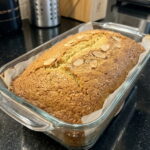
The top should become lightly golden, and the center should feel set rather than wet.
Insert a toothpick or thin skewer into the center. It should come out without wet batter clinging to it.
Because the bread contains eggs, you can also check the center with a food thermometer. Aim for at least 160°F (71°C).
If the surface browns too quickly before the middle is cooked, loosely cover the loaf with aluminum foil and continue baking.
Avoid removing the bread simply because the top looks golden. The center needs sufficient time to cook through.
Remove the pan from the oven and let the loaf cool in the pan for 10–15 minutes.
Carefully lift it out using the parchment paper and transfer it to a wire rack.
Allow the bread to cool completely before slicing for the cleanest results.
This cooling stage is especially important for almond flour bread because it can be delicate while hot. As it cools, the structure becomes more stable and the slices are less likely to crumble.
Once the loaf has cooled, use a sharp knife to cut it into slices.
Serve the bread plain, spread with butter, or topped with avocado, cream cheese, eggs, or your favorite sandwich fillings.